
November 2, 2026 / Esther Choy
In response to my recent article recommending these 5 books on curiosity for business leaders, I reached out to the authors and asked them further about their understanding of the value of curiosity. Here’s our full exchanges, unedited.
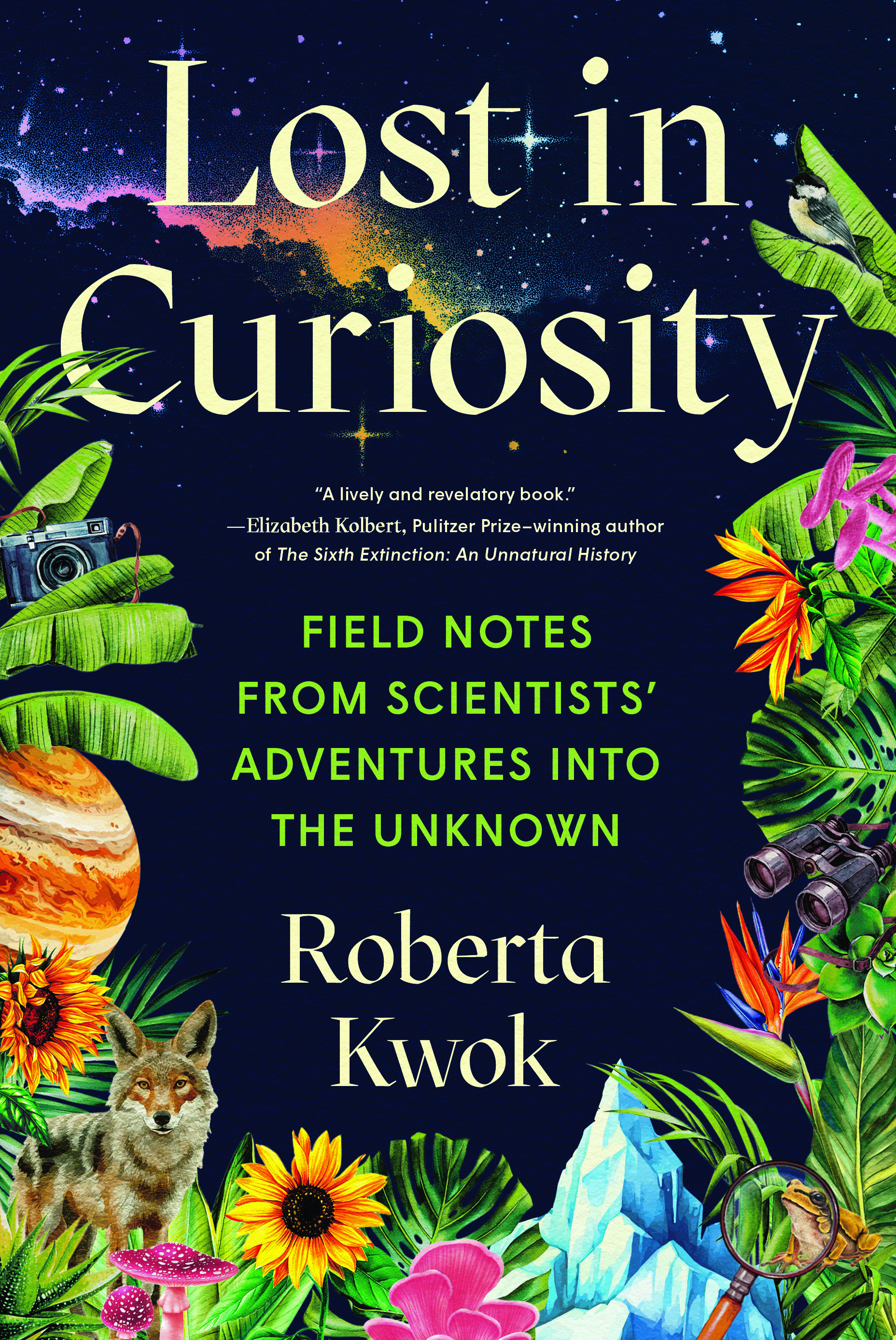
Roberta Kwok: Lost in Curiosity: Field Notes From Scientists’ Adventures into the Unknown
Esther: In following scientists through failed experiments, detours, and long stretches of uncertainty, did you encounter someone whose curiosity actually changed because of a setback? What happened?
Roberta: The person who comes to mind is David Kipping, an astronomer who dedicated many years to searching for an exomoon—a moon orbiting a planet outside our solar system. Time after time, he thought his team had discovered a moon, only to have the evidence crumble beneath their feet.
For Kipping, these constant disappointments hardened his objectivity; he became ruthless about discarding moon candidates if he had the slightest reason to suspect they might not be real. And when his team did finally discover what seemed to be a genuine exomoon, he told me that he had “no feelings” about it. I thought that was sad, but he saw his reaction as a good thing because he didn’t want emotions to color his scientific judgment.
In contrast, Apurva Oza, another astronomer on a similar quest to find moons, thought that emotional attachment was an important part of being human. Rather than distancing himself from the outcome completely, he strove for equanimity—not overly attached to his goal, but also not detached.
Overall, though, scientists seem curiously impervious to setbacks. I followed a glaciology team trying to collect data on Helheim Glacier, an incredibly remote site on the Greenland ice sheet. The researchers ran into one obstacle after another: storms, fog, helicopter issues, equipment buried under snow, sickness in the field.
But one scientist, Winnie Chu, told me that she’d keep doing this work as long as critical questions about sea-level rise remained unanswered. I asked if she’d be out on the ice sheet at age 85, meaning it as a joke. Without missing a beat, she said that as long as she was physically qualified, she would still go.
Manbir Kaur, Curiosity (HBR Emotional Intelligence Series)
Esther: In your experience, how do good leaders with good listening skills contribute to the greater success for their organization?
Manbir: In more than 18,000 hours of coaching senior leaders, I have seen that the leaders who listen well to others have first learned to listen to themselves. They know what they value and what triggers them. They know what they want to build. That self-awareness keeps them grounded.
Good listening helps a leader-
- They ask powerful questions. Their curiosity is real. They want to understand before they want to be right.
- People feel heard. When people feel heard, they bring their full thinking to the table. That includes the bad news, and the half-formed idea that could become the next big thing.
- They empower others. A grounded leader does not need to be the smartest voice in the room. So they make space for other voices.
This is where the business gains. When people feel unheard or unsafe, they slip into fight-or-flight. They protect themselves and react. When a leader truly listens, the room settles. People stop protecting and start thinking. They see the bigger picture. They connect their own work to the priorities of the team, the business unit and the organization. Together, they think bigger.
Over time, that adds up to sharper decisions, faster alignment, and people who choose to stay.
Paloma Valdivia, Illustrator of Book of Questions by Pablo Neruda
Esther: Neruda’s questions often defy logic and resist answers. When you began illustrating them, how did you decide what to make visible while preserving the mystery of the question?
Paloma: Illustrating Neruda’s questions without closing them off with an answer was a huge challenge. My goal was not to explain them, but to expand them poetically and metaphorically, so that the illustration would act as an echo of the poem rather than a solution. To achieve this, I immersed myself in Neruda’s life and work, and together with my editor, Claudia Bedrick, we spent five years talking to find that exact balance: creating images that opened portals to the imagination instead of offering a single interpretation. The key was to illustrate the space of wonder and doubt, allowing the image to hold a dialogue with the mystery without ever resolving it.
Esther: Leaders are often expected to bring clarity to ambiguity. As an artist, have you found that leaving something unresolved can sometimes lead to more interesting discoveries than trying to explain it?
Paloma: Absolutely. I am convinced that open-ended works are infinitely richer than definitive answers. Great art and literature do not give us certainty; they leave us with questions. It is up to the reader or viewer, drawing from their own experiences, memory, and context, to complete the work and tailor its meaning to themselves.
In the creative process, something similar happens with errors or uncertainty: an unexpected ink stain or a dead end might seem like a problem at first, but it often becomes the starting point for the most fascinating discoveries. If we never asked unanswered questions or dared to embrace mistake as part of the journey, neither art nor humanity would be where it is today. Ambiguity is not a vacuum to be filled immediately, but a fertile ground for innovation.

Philip Ball, Curiosity: How Science Became Interested In Everything
Esther: Curiosity was once considered a vice, yet today many organizations claim to value it. From your historical perspective, what are the less obvious ways that institutions discourage curiosity even while publicly embracing it?
Philip: Great question! One of the points I make it my book is that curiosity has, throughout time, always come with an agenda attached. We hear a lot about “curiosity-driven research” in science today, and I’m all in favour of that. But I think we need to look closely at what that formula really means. The Large Hadron Collider at CERN, the huge machine used for particle physics experiments, was billed as a “curiosity machine” – but there are complicated questions to be asked about how to bal-ance such curiosity against the substantial investment it demands in comparison to some other areas of physics, and whether – as physicists are new debating – an even bigger and more expensive col-lider can be justified on the grounds of “curiosity” if we just don’t know what new physics, if any, it might reveal. Some defend curiosity-driven research on the basis that there’s an eventual societal payoff in terms of spin-off technologies, boosts to national productivity, or the like. These benefits may or may not be true, but the argument is different from valuing curiosity for its own sake. In his famous 1945 document The Endless Frontier, Vannevar Bush, a key scientific adviser to US president Harry S. Truman, argued for the value of basic, curiosity-driven science in part because of its importance for national security. There’s nothing inherently wrong with these arguments, but we should be aware of the agenda.
But is curiosity sometimes apparently advocated while in fact being suppressed or discouraged, as you say? I certainly think the value of scientific inquiry is being abused by, for example, talk of “Gold Standard science” by the Trump administration, which is not at all open to being guided by what science actually reveals. I think we must be cautious too about the motives of AI companies – for example in the way that some of their maths models, while producing undeniably impressive results, seem to be used as prestige projects for the company’s image. I believe that the real dangers, then lie with authorities and powerful bodies that leverage the appeal of “curiosity” in bad faith.
Esther: Throughout history, curiosity has challenged accepted knowledge and those who hold power. What distinguishes leaders who genuinely welcome uncomfortable questions from those who tolerate questions only as long as their authority remains intact?
Philip: The issue might not be so much about curiosity and questions per se but about what they yield: whether leaders will accept what curious inquiry tells them. And then the question is whether denial is about power or ideology. It’s not obvious that accepting climate change or the effectiveness of vaccines would threaten Trump’s power, but it doesn’t fit with his ideology or that of his supporters and enablers. Stalin encouraged the denial of Darwinism exhibited by his agricultural minister Tro-fim Lysenko because it was deemed to be inconsistent with Marxist ideology – with disastrous con-sequences for crop yields and thus the Soviet population. But he did not really hinder the freedoms of his nuclear physicists, because he needed their expertise in the service of his power. (Of course, the dissident nuclear physicist Andrei Sakharov was placed under house arrest, but that was after he had helped develop the Soviet bomb.)
To look for clear examples of curiosity being suppressed with the aim of preserving power, we’d need to look to the Christian church in the Middle Ages and earlier, for which open-ended enquiry into nature was sometimes seen as liable to challenge the authority of the Scriptures and, by extension, of the priests. Even so, many of the most curious people in the Middle Ages, such as Roger Bacon and Robert Grosseteste, were clerics! So that’s a complicated story.

Scott Shigeoka, Seek: How Curiosity Can Transform Your Life And Change The World
Esther: Curiosity sounds appealing until we encounter someone whose beliefs or behavior we find genuinely objectionable. How do we remain curious without feeling that we’re compromising our own values?
Scott: This is a question I get a lot. When someone holds a belief that’s different from ours or feels harmful, curiosity can feel like a betrayal. There’s a prominent cultural belief that simply asking people questions and getting genuinely curious about them means we are normalizing or saying their perspectives are okay.
But, I’d push back on the notion that curiosity is a form of agreement or an endorsement. You can still hold your own beliefs and viewpoints while learning why others feel or think the way they do, especially when their perspective differs from yours. This not only helps you learn more about others and the world you both inhabit, but it’s through that shared understanding that we build stronger relationships and collaborations to build a country that’s truly better for all—because everyone is considered and included in that pursuit.
Rather than discussing only their beliefs or opinions, I’d go even deeper: Ask them to focus on personal stories. What experiences or people shaped their beliefs? What fears or hopes do they have? What life experiences do they think others went through that led to a different viewpoint than their own?
Curiosity also has boundaries. You don’t owe it to anyone who threatens your safety or denies your humanity. Similarly, just because someone is curious doesn’t mean they’re entitled to that information. Someone can be curious about your hair, culture, or whether you’re pregnant or not—but it doesn’t mean you have to answer their questions. But, we’re usually more open to answering vulnerable questions if we have the trust and relationship built first—and paradoxically those can be fostered with a practice of curiosity. It’s a loop! 🙂
Esther: Have you witnessed a time when someone’s genuine curiosity changed a relationship that seemed beyond repair? What did that person ask or do differently?
Scott: I’d widen the lens of this question, as the relationship that needs the most repair right now is our relationship to the future—and to each other as people who can build it together. But we’re lacking the imagination and the belief that it’s possible. Research by PolicyLink found that most Americans want a democracy where everyone is included, but most don’t believe it’s possible to achieve. Curiosity is a practice to close that “belief gap” because it allows us to encounter stories we aren’t typically exposed to on social media or the news, ones that allow us to see that people are already coming together to build a future that is better for all.
That’s why I spent seven months on the road in my Curiosity Mobile, a purple vinyl-wrapped van, looking for unsung heroes: people working in libraries, as nurses, on farms, with schools, and lesser-known community organizers who deserve recognition. I wanted to share meals with them, visit their homes, learn from them, and build real connections.
In Texas, I met Audrey, a librarian who believes we all have the right to read and that our democracy depends on the free and open exchange of ideas. When book ban legislation came for her library, she contested it, which led to threats against her work and life. She showed me challenged titles from the Krause list—a compilation of more than 800 books targeted for banning—books like Isabel Wilkerson’s Caste and Ta-Nehisi Coates’ Between the World and Me. Since 2021, there have been over 22,000 instances of book bans across 45 states and 451 public school districts, and librarians like Audrey have been at the heart of challenging them. Her story was also told in the film The Librarians, which just received a Primetime Emmy this year.
In North Carolina, I met Amy, Adrienne, and Ponkho, three roommates leading BeLoved Asheville in the aftermath of Hurricane Helene. They found temporary shelter for displaced neighbors, provided food and water, and gave direct cash to people during the rebuild. Their guiding narrative frame was that relationships matter and we ought to show up for each other, and they saw it every day: someone setting up a BBQ smoker to feed people, a farmer installing reverse-osmosis water systems so schools could reopen, and volunteers who helped rebuild over 100 homes.
In West Virginia, I met Steven, who comes from a family of coal miners and ran into trouble when he was younger. Coalfield Development helped him get back on his feet, take classes, and find work. Now he leads Highwall, an abandoned strip mine that he and his team transformed into a regenerative farm. He walked me through the land with his dogs and children in tow: new trees and grass taking root, soil being nurtured back to life, produce growing for the community, animals rotationally grazing across once-scarred earth.
I didn’t forget the problems we face, but I was no longer just stewing in the negative narratives of doom and gloom that we are fed from all directions. I was out practicing my curiosity by meeting people face-to-face who were caring for their communities. Curiosity repaired my belief that a better future is possible, because I saw the people who are already building it.




Better Every Story
Leadership Transformation through Storytelling
"This is an amazing and insightful post! I hadn’t thought of that so you broadened my perspective. I always appreciate your insight!" - Dan B.
Get Esther Choy’s insights, best practices and examples of great storytelling to your inbox each month.