
November 11, 2026 / Esther Choy

Expertise helps you land a job, but curiosity helps you increase your impact once you’re there. When you are willing to pause and ask your team, “Tell me more,” this is a sign of curiosity. It means you notice something might be missed if you don’t ask to learn more about what wasn’t yet fully expressed.
When curiosity takes hold of a team, the impact is incredible. Conversations get more honest, assumptions are questioned, and new information and ideas are discovered. When this happens, trust and innovation are unleashed. I asked four experts — from science, history, leadership, and art — what they’ve learned about curiosity through their specific disciplines. Here’s what they had to say.
Curiosity Starts With The Self
Manbir Kaur, a leadership coach and one of the authors featured in Curiosity (HBR Emotional Intelligence Series), believes that curiosity starts with self-understanding. She told me, “I have seen that the leaders who listen well to others have first learned to listen to themselves. They know what they value and what triggers them. They know what they want to build. That self-awareness keeps them grounded.” While many leaders have explored their values in depth, not all leaders take the time to be aware of the behaviors and scenarios that irritate them and cause them to react without thinking (leading to unfavorable outcomes). Being curious about ourselves helps us stay grounded when conflict or unforeseen challenges arise. We won’t be unmoored because we know ourselves well.
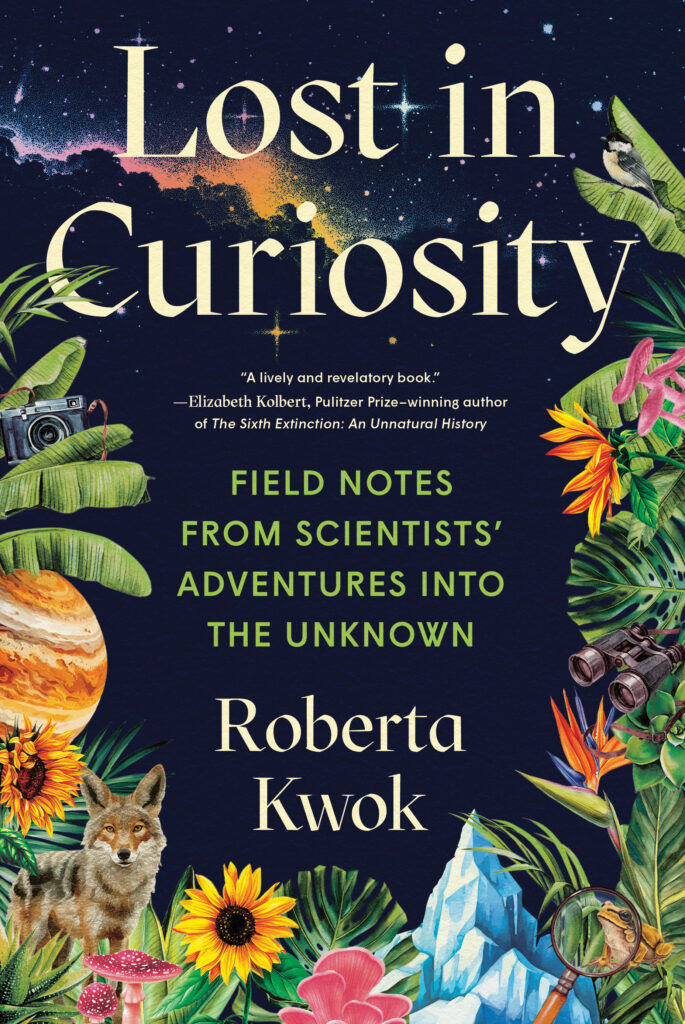
Listening is the main highway between curiosity and discovery. You could be curious, but may or may not discover anything interesting if you don’t learn to listen. Science writer Roberta Kwok has seen how a scientist’s curiosity is tied to their ability to listen. In her book, Lost In Curiosity, she writes about how scientists often face near-existential challenges while pursuing their goals. I asked her if she’s seen these setbacks change the nature of a scientist’s curiosity.
She answered, “Overall, though, scientists seem curiously impervious to setbacks.” However, “David Kipping, an astronomer who dedicated many years to searching for an exomoon—a moon orbiting a planet outside our solar system. Time after time, he thought his team had discovered a moon, only to have the evidence crumble beneath their feet.” The years of disappointment made him more objective, which he saw as a good thing. When his team finally did believe they had found an exomoon, he had “no feelings” about it.
She also told me about another astronomer: “In contrast, Apurva Oza, another astronomer on a similar quest to find moons, thought that emotional attachment was an important part of being human. Rather than distancing himself from the outcome completely, he strove for equanimity—not overly attached to his goal, but also not detached.”
Scientists remain strongly curious and continue to listen to the data they are collecting, but they are not dogmatic about the outcome. They are able to stay curious even when evidence doesn’t support the outcome they were hoping for. In business leadership, this dogma-free curiosity is essential. If you are asking questions because you are hoping to hear a certain answer, you are bound to miss key moments where discovery could occur.
In business, this is what good, dogma-free listening can look like: For years, Stewart Butterfield poured all of his time and creative energy into an online game called Glitch. When all evidence pointed to the fact that it was failing – it cost too much, had too few players, and none of their new features brought in better results – he knew it was time to pull the plug.
But he was able to pivot. The internal messaging framework his team had built for the game had the potential to be useful. “It’s all your team’s communication in one place, synced, searchable, and available wherever you go,” Butterfield described. A year later, he launched Slack. Though he devoted years to Glitch, Butterfield was able to let go of his beloved game and, therefore, successfully created a product that is profoundly useful to millions of people.
The Dangers of Curiosity
Philip Ball, author of Curiosity: How Science Became Interested In Everything, looks at curiosity through a more historical lens and told me that curiosity often comes with an agenda. He gave me this example, “In his famous 1945 document The Endless Frontier, Vannevar Bush, a key scientific adviser to US president Harry S. Truman, argued for the value of basic, curiosity-driven science in part because of its importance for national security. There’s nothing inherently wrong with [this], but we should be aware of the agenda.”
He went on to connect to today’s leaders of curiosity: “We must be cautious about the motives of AI companies—for example in the way that some of their maths models, while producing undeniably impressive results, seem to be used as prestige projects for the company’s image. I believe that the real dangers, then, lie with authorities and powerful bodies that leverage the appeal of ‘curiosity’ in bad faith.”
When I asked Ball if he had seen organizations that outwardly valued curiosity, but actually discouraged it internally, he said, “The issue might not be so much about curiosity and questions per se but about what they yield: whether leaders will accept what curious inquiry tells them. And then the question is whether denial is about power or ideology.” He pointed to the Christian church in the Middle Ages, which didn’t support open inquiry into nature as they feared it would challenge priests’ authority.
Read together, with Kwok’s and Kaur’s insights on curiosity, business leaders can learn that curiosity must not be tied to a certain outcome and leaders must be secure in their own leadership to truly value the innovative power of curiosity, even when curiosity leads us toward uncertainty.
Curiosity: Embracing Mistakes And Uncertainty
Artist Paloma Valdivia sheds light on this. “Leaders are often expected to bring clarity to ambiguity.” And I asked her, “As an artist, have you found that leaving something unresolved can sometimes lead to more interesting discoveries than trying to explain it?”
“Absolutely.” Valdivia shared, “I am convinced that open-ended works are infinitely richer than definitive answers. Great art and literature do not give us certainty; they leave us with questions. It is up to the reader or viewer, drawing from their own experiences, memory, and context, to complete the work and tailor its meaning to themselves. In the creative process, something similar happens with errors or uncertainty: an unexpected ink stain or a dead end might seem like a problem at first, but it often becomes the starting point for the most fascinating discoveries. If we never asked unanswered questions or dared to embrace mistakes as part of the journey, neither art nor humanity would be where they are today. Ambiguity is not a vacuum to be filled immediately, but a fertile ground for innovation.”
The True Value of Curiosity
Kaur shared that grounded and curious leaders are the best kind of listeners. She said that when people feel heard, “they bring their full thinking to the table. That includes the bad news, and the half-formed idea that could become the next big thing” and “a grounded leader does not need to be the smartest voice in the room. So they make space for other voices.”
This, she said, is where a business finds the benefits of curiosity: “When people feel unheard or unsafe, they slip into fight-or-flight. They protect themselves and react. When a leader truly listens, the room settles. People stop protecting and start thinking. They see the bigger picture. They connect their own work to the priorities of the team, the business unit and the organization. Together, they think bigger. Over time, that adds up to sharper decisions, faster alignment, and people who choose to stay.”
An example from my book, Winning Without Persuading, shows how curiosity about typical leadership protocol was able to produce deeper alignment across a company. Ron Carucci, a business coach, was brought in to help a CEO improve her leadership. He saw that her calendar was full of one-on-ones and was curious about their impact. After listening and observing patterns, he found that the problem wasn’t how often she met with other leaders, but that they met alone, which reinforced information silos and slowed progress. His advice was to replace many one-on-ones with small cross-functional “capability meetings,” where teams could practice curiosity and listening together. In these team meetings, silos of information were dismantled, problems were solved faster, priorities became shared, and the loop closed faster.
Putting Curiosity To Work
Across science, history, art, and leadership, the experts I interviewed returned to the incredible value of curiosity. It begins with knowing yourself well enough to stay grounded, it holds on to results loosely enough to be surprised and agile, and it treats uncertainty and mistakes as places where discovery can begin.
Roberta Kwok told me about a team of scientists whose research required traveling to remote glaciers. “The researchers ran into one obstacle after another: storms, fog, helicopter issues, equipment buried under snow, sickness in the field. But one scientist, Winnie Chu, told me that she’d keep doing this work as long as critical questions about sea-level rise remained unanswered. I asked if she’d be out on the ice sheet at age 85, meaning it as a joke. Without missing a beat, she said that as long as she was physically qualified, she would still go.”
This kind of tenacity is what business leaders need to embody curiosity at work. While our data points are not lodged in the ice sheets of Greenland, it takes the same kind of tenacity to ask the tough questions and remain in the awkward silences to discover the stories in the people we are leading. That means asking “Tell me more” without needing a particular answer, and being secure enough to hear what comes back. When a team feels heard, people trust each other enough to share openly. And that’s where better decisions and real innovation take place.
Each of these experts offered more than I could fit here, so if you’d like to read our full interviews about curiosity across disciplines, they are linked here.



Better Every Story
Leadership Transformation through Storytelling
"This is an amazing and insightful post! I hadn’t thought of that so you broadened my perspective. I always appreciate your insight!" - Dan B.
Esther Choy is the CEO and Chief Story Facilitator of Leadership Story Lab. Get her insights, best practices and examples of great storytelling to our inbox each month.