
November 12, 2026 / Leadership Story Lab
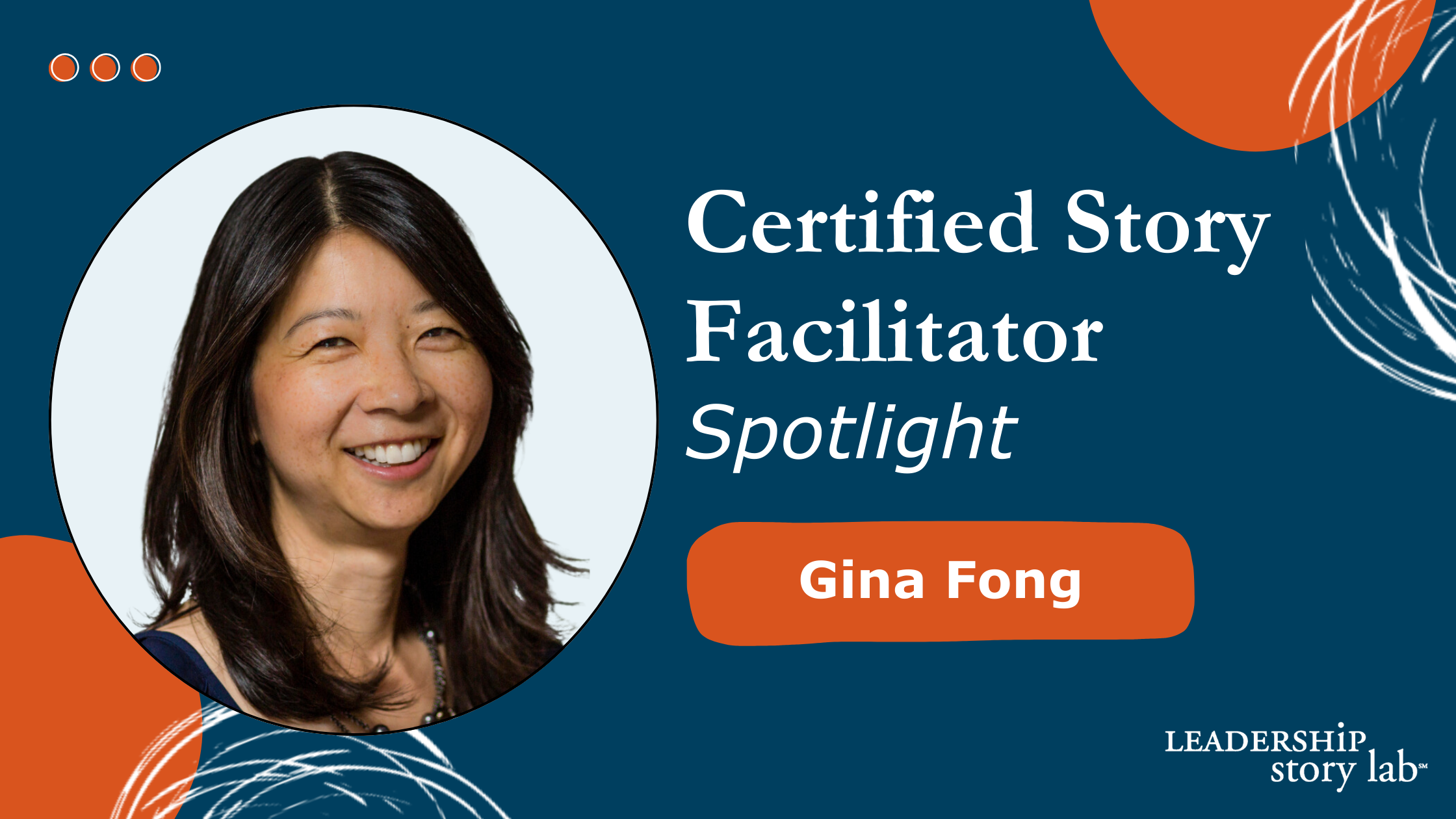
Gina Fong is Clinical Assistant Professor of Marketing at Kellogg School of Management at Northwestern University. She came to Leadership Story Lab during the COVID shutdown to help her keep her class engaged when everything moved online.
“We were all freaking out,” Gina recalled in our recent interview about those first weeks of the COVID shutdown. “How are we going to keep adults interested in a class for three hours straight?”
Little did she know that questions like this one would help her achieve an incredible milestone just three years later, after most classes had returned to the classroom.
Gina had learned about Leadership Story Lab and took a complimentary class called Story Lab. Then she met Esther on Zoom and learned that they were “fraternal work twins.”
“We do very similar things, but just a different side of the coin. I took to Esther, Reena and the content they were teaching immediately.” So she signed up for Certified Story Facilitator training and is now a Level 3 Certified Story Facilitator (CSF).
When she is not teaching, you may find Gina Fong in the homes of strangers as they plug in their printers or dye their hair, taking notes. This is because Gina is a consumer anthropologist. Using the tools of ethnography — like immersing herself in the space and homes of the people she is studying — she helps businesses understand the people who use their products.
By watching people in their real lives using real products, she learns all sorts of things that the makers of the products would have never been able to guess. When she observed women in their homes using hair dye a few years ago, she learned the product was so slippery and staining that women would dye their hair in the basement or use rags instead of towels. This was a far cry from the salon experience the company had envisioned. Gina’s discovery helped the company develop a new line of foaming hair products that was easier to use.
“It’s understanding who people are and what makes them tick. And that means understanding other people’s stories,” Gina told me during our interview. “There’s a natural intersection, not only with anthropology and business, but storytelling because it’s ultimately about understanding other people.”
She believes that giving someone the gift of understanding is the most human-centric thing we can do.
Leadership Story Lab: Let’s dive in. What was CSF like?
Gina: The exercises, the topics, and the final project that Esther does for each level, they’re unique and twist your brain. It’s really, really fun.
It’s not just “write a story and present it to the class.” Esther makes you think about things in a different way and how to share stories. I appreciate the prompts she puts into the work and the assignments we did outside of our meeting times because it just makes you more creative.
Leadership Story Lab: How has Certified Story Facilitator Training impacted your work?
Gina: When we went back into the classroom after COVID I felt more prepared because I could really use my storytelling skills that Esther had coached me through. You could be in a classroom with a bunch of students and put slides up and talk about the slides all day long. Students could go back and look at the slides and look at their notes and read a textbook and try to absorb it that way.
Or I could follow Esther’s IRS model and teach a class like that. There’s an intriguing beginning. There’s a riveting middle. There’s a satisfying end.
Leadership Story Lab’s signature storytelling framework is IRS and it stands for Intriguing beginning, Riveting middle, and Satisfying end. It’s designed to help leaders craft compelling stories in three moves:
-
- Intriguing Beginning: Open with something unexpected that sparks curiosity and pulls the audience in before they realize they’re hooked
-
- Riveting Middle: Identify the central tension and hold it taut, trusting only the most necessary details to carry the narrative forward
-
- Satisfying End: Circle back to the opening idea, answering the questions raised at the start while leaving space for the audience to reflect
Gina and many other CSF have learned to use IRS not just as a way to structure a story, but to structure almost anything — from lesson plans to sales pitches, and team meetings.
I have students who don’t take a single note in class who will see me two, three years later, and they’ll remember the class because of the story arc I’ve woven around the lesson itself.

Leadership Story Lab: How do you actually build a lesson around that IRS model?
Gina: It’s not just a story to tell a story. There’s a reason for the story that connects it to the content that I’m trying to teach that day. And it makes everything stickier.
So a metaphor that I use a lot in my work is around the concept of the gift. In my class, there’s always a story and there’s an accompanying metaphor. So when I typically teach at Kellogg, the first class is about how giving a gift of understanding to a loved one is the same skill set you need to design a product, a service, or a brand for your customers.
You want to surprise and delight them. So there’s a story I tell in the beginning of class about a gift that I received.
Then the riveting middle, is there’s a lesson about how you do that, how you give a good gift in your personal life, and then how those skills translate into the business world.
A lot of times people are like, “Oh, that’s a pleasant story” in the beginning. And then they forget about it, because then you get into the meat of the class. But then I bring that initial story around to the end and reveal more about the meaning of that gift that ties the entire class together.
Leadership Story Lab: How have you applied facilitating aspects of CSF in your work? Do you help your students learn how to tell stories?
Gina Fong: Yeah, absolutely. One of the reasons why I took CSF was so I could help my own students tell stories. In my class, they work with a client sponsor. And at the end of the quarter, they have to present their research findings to this client.
It’s a real-life client project, real research that the client’s going to use. And just like I can’t stand in front of the students and bore them to death with 100 slides, I don’t want them putting up 100 slides of research and boring their client.
So a lot of what I learned in CSF, I teach to my students in a class, and then they follow the IRS model as much as they can when they’re putting their decks together for the client. So I do a lot of facilitation.
Esther shares more deeply about the adventures of collaborating with Gina in her new book Winning Without Persuading.
Leadership Story Lab: What is it about the IRS model that makes you go back to it again and again in your classroom?
Gina: It’s simple. It’s memorable. And it’s just enough framework and structure without overdoing it. Esther teaches us this framework in her lessons: it’s just enough structure to get started while also providing creative freedom.
If you don’t know where to start, start at the end. And that’s where I usually start. When I’m developing class content, I ask myself, ‘Where do I want students to land?
And then I work myself backwards. So I could be stuck for weeks trying to get a class started and figuring out what the story should be in the lesson.
But when I go to what is that satisfying end? Where do I want students to land? And when I figure that out, then the rest of it becomes so much easier.
So it’s not only a structure to tell the story, it’s a structure for me to get the work started.
You start to see IRS everywhere. You see it in the movies. You see it in TV commercials. You see it in books. It’s one of those things that once you know it, you can’t unsee it.
The structure does exist in all of these other media and forms. It makes perfect sense. It’s just the way Esther has packaged it that makes it sticky.
Leadership Story Lab: Are there other takeaways you have from CSF?
Gina Fong: My graduation speech was something where I really had to practice pitch and pause and pacing — the expressive parts of the story. It’s one thing to get the story right, but then how do you share it, especially when the stakes are high and the audience is big?
So really learning how to deliver a good story is part of this practice as well.
In 2023 Prof. Gina Fong was the first woman of color to earn “Outstanding Professor of the Year” at Kellogg School of Management. With this honor, comes the opportunity to give a speech at Kellogg School of Management Convocation. Watch Gina give her speech about the gift of understanding. She worked with Esther and used Leadership Story Lab methodology to prepare for this speech.
Leadership Story Lab: How does CSF and Leadership Story Lab compare to other professional development programs you’ve been a part of?
Gina Fong: I haven’t taken a lot of other storytelling development programs because once I found Esther and Reena, it was like being home. So I can’t compare those programs, but I will say what’s interesting is the community that Esther’s able to build.
This program attracts a certain type of person that when you get into the room, you feel like these are your people. It is the strangest feeling in the world. I don’t know how she does it. There’s some superpower she has, but I remember my core group, there were four of us.
We bonded so much. And there’s one woman, named Karma, who lives in Australia. I probably will never meet her in my lifetime, but if I’m in Australia, you bet I’m going to go find her.
Because you share these stories. There’s a vulnerability. There’s this sharing and deep acceptance of other people and where they’re coming from and where they’re going. You just feel really bonded and it’s such a safe space. You’re sharing very vulnerable stories. You’re flubbing things all the time.
We’re messing up our story. And it’s perfectly fine. We’re all working it out together. And it creates this really awesome, collaborative, safe environment.

Leadership Story Lab: What do you think makes it a safe environment? We use the word “safe space” a lot, but what actually makes it safe.
Gina Fong: There’s that term that everyone uses psychologically safe. CSF creates a safe space because 1) Esther sets the tone. And then 2) we’re all learning. None of us think we have arrived. We all have a beginner mindset. When we all agree that we’re beginners, then we’re all the same. And so no one is better than someone else.
No one’s more experienced than someone else. And we’re all just cheering each other on. And that’s really awesome. And we’re all giving each other feedback during these things.
And I think that’s really lovely because we’re all at the same starting line. And we know that we all want to make progress.
So we’re just helping each other out during that process.
Leadership Story Lab: A part of the CSF is the ongoing professional development. What’s your experience with that?
Gina Fong: I am constantly honing my own storytelling. Like practicing a sport, I get on the field and run reps with my teammates so I’m in storytelling shape! In the first year the monthly professional development sessions were really helpful.
Then I got busier and I could do the reps on my own. The professional development series is like going to a personal trainer. I highly recommend them to everyone coming out of the program for at least the first year, because it just kind of keeps that muscle strong and keeps you in the habit of practicing.
Esther and Gina have joined together in other ways to bring people into the world of storytelling and understanding. They wrote a Harvard Business Review article together: A Great Sales Pitch Hinges on The Right Story. Their article was selected to be in the 2027 Harvard Business Review’s 10 Must Read on Sales
Gina Fong: The article was fun to write, but I’m probably most proud of last year at the Kellogg Women’s Global Summit.
We had a center stage and we dissected my speech from the convocation. That was really lovely because, again, you could see the fraternal work twin really in its element.
I’m talking about the experiences I have as an anthropologist and how I’m writing the speech. And Esther’s talking about the behind the scenes, the construction of it, the delivery of it.
It was a really well-received talk in the way that we took the speech, broke it down, and gave the audience, I hope, some very actionable steps on how to apply this for themselves.
Business leaders will always be in a position — whether it’s in front of a company or giving a speech like I did in front of convocation — to tell important messages. Wrapping it up in story, it elevates the work.
Transformational Perspective: How To See Stories In Everyone
Here’s Why Curiosity Is A Skill Nonprofit Leaders Need To Master



Better Every Story
Leadership Transformation through Storytelling
"This is an amazing and insightful post! I hadn’t thought of that so you broadened my perspective. I always appreciate your insight!" - Dan B.
Get Esther Choy’s insights, best practices and examples of great storytelling to your inbox each month.